Comparing the 2026 Mazda3 to the Competition
Though always referred to as the Familia in Japan, Mazda went through many names for its compact car line for a few decades before settling on Mazda3. The Mazda3, introduced for the 2004 model year, took things to a whole new level. Offered as both a sedan and a 4-door hatchback, the car was still fun to drive but felt much more substantial, with an interior rivaling those of luxury brands. It was, in fact, built at the Hofu plant originally designated for Mazda’s aborted luxury-brand models. Shoppers noticed, and sales exploded.
The 2026 model is the fourth generation of the nameplate, and everything appreciated about previous models has been stepped up. The interior looks premium, while the Kodo exterior design language lets seductive curves do all the talking without any fussy details. There are many configurations for the car. In addition to the sedan and provocatively attractive hatchback, there are two engines, front-wheel drive (FWD) or available all-wheel drive (AWD), and even an available manual transmission; though not everything mixes with everything else.
The standard engine is a 2.5-liter inline-4 producing 186 horsepower and 186 lb-ft of torque. The top turbo trim adds a turbocharger to the same engine, producing 227 horsepower and 310 lb-ft of torque, and includes standard AWD. Both engines are paired with a 6-speed manual transmission, and AWD is also available with the base engine. The manual transmission is also only available with the base engine.
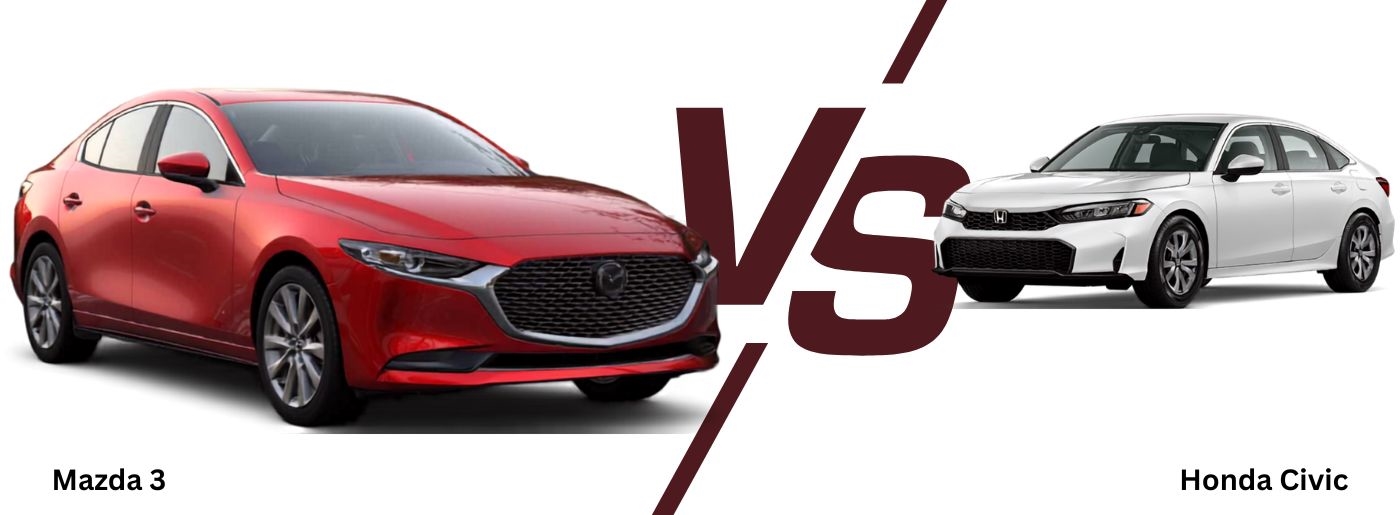
Mazda3 vs Honda Civic
The Civic has a long history dating back to its introduction in 1972, when it effectively showed the U.S. what a small car should be. Like the Mazda3, it is available as both a sedan and a hatchback, and it has also been offered as a coupe, a wagon, and even a 2-seater. The Civic is one of the highest-selling models in the class. It has always been powered by 4-cylinder engines and has been limited to FWD, including the overtly high-performance Type-R model.
Setting the nearly $50K Type-R aside, today’s Civic features a conventional gasoline engine and a single hybrid powertrain. The conventional engine is a non-turbocharged 2.0-liter producing 150 horsepower and 133 lb-ft of torque; it is paired with a continuously variable transmission (CVT), except on the Si hatchback performance model, which exclusively features a 6-speed manual. Hybrid models use the 2.0-liter engine primarily as a generator while the electric motors propel the car. At highway speeds, the engine powers the car directly. This effectively eliminates the transmission except for reverse, neutral, and park functions. The Civic comes in LX, Sport, Hybrid Sport, Si, Hybrid Sport Touring, and Type-R trims.
- The Mazda3 and Civic sedans have nearly the same starting MSRPs ($24,650 vs. $24,696). But the Civic hatchback MSRP jumps by over $3K to $27,895, while the Mazda3 only increases by $1K to $25,850.
- When comparing base engines, the Mazda3 has notably more horsepower (186 vs. 150) and torque (186 vs. 133 lb-ft) than the Civic.
- Both models are unique in offering a 6-speed manual. However, when it comes to automatics, Mazda never compromises on driving engagement, opting for the sharpness and predictability of a 6-speed automatic over the Civic CVT.
- Helpful for seating three in the rear, the Mazda3 provides two more inches of hip room (50.9 vs. 48.9).
- Both models have attractive dashboards for the class, but the Mazda3’s is considered more luxurious in design and materials.
- The Mazda3 sedan and hatch earned TOP SAFETY PICK + ratings, the highest offered by IIHS. The Civic earned a TOP SAFETY PICK rating, one step down.
- Both models earned Overall 5-star ratings from the NHTSA.
- Mazda and Honda are ranked next to each other in the J.D. Power Vehicle Dependability Study, which assesses dependability after three years of ownership. Mazda is slightly higher, with one fewer problem per 100 models.
- The Mazda3 comes with a standard 8-speaker audio system, whereas the Civic has only 4 speakers.
- In addition, both models offer a 12-speaker Bose audio system, but the Mazda3 makes it available on several trims, whereas the Civic offers it only on the Si.
- Blind-spot detection is standard on the Mazda3 but not on the Civic.
- At the high end of the model lineup, the Mazda3 offers the convenience of a surround-view camera system and a head-up display, neither of which is available on the Civic.
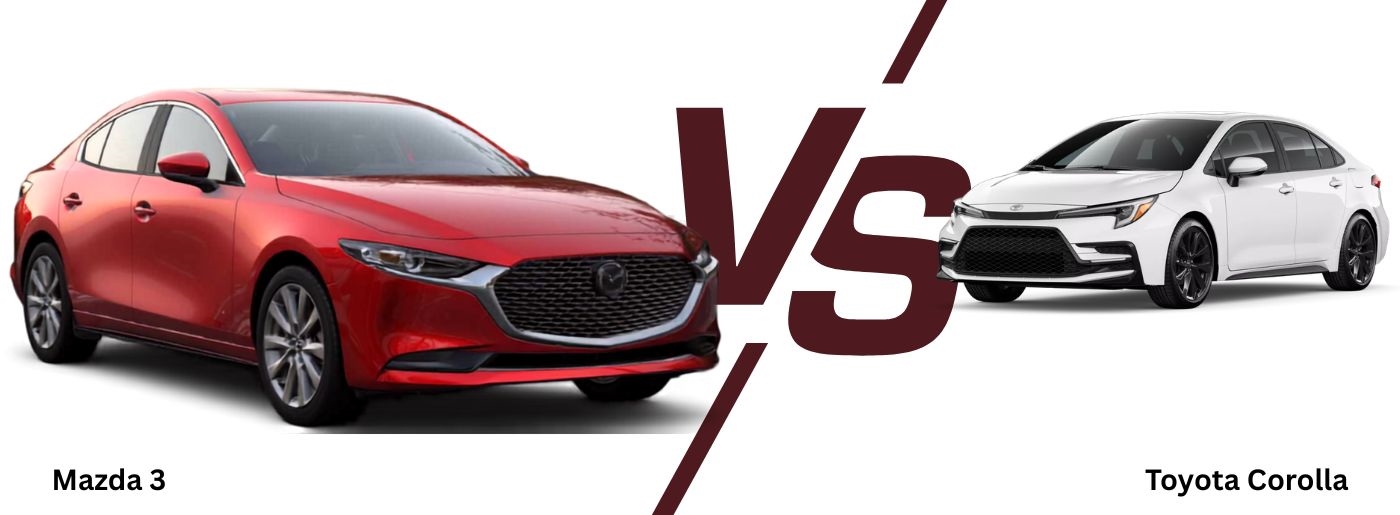
Mazda3 vs. Toyota Corolla
The Corolla is the oldest nameplate in this comparison and in the category as a whole, dating back to 1966, with a U.S. introduction in 1968. It started as a front-engine, rear-drive model and transitioned to FWD in 1983. The twelfth-generation Corolla, launched in 2022, is available in both sedan and hatchback body styles. There is more differentiation between the sedan and hatch in the Toyota model line, with a three-inch difference in wheelbases and entirely different sheet metal and styling. Together, the Corolla model line is the second-best-selling vehicle in the world, though it ranks about twelfth in the U.S. market.
The base Corolla engine is a non-turbocharged 2.0-liter inline-4 producing 169 horsepower and 151 lb-ft of torque. A hybrid drivetrain is also available for the sedan only. It uses a 1.8-liter engine and delivers a total system output of 138 horsepower. The turbocharged, AWD high-performance GR Corolla is another animal altogether and is not covered in this comparison. Corolla trim levels include LE, SE, and XSE, and all three sedan versions are available with the hybrid drivetrain.
- The Mazda3’s standard engine has notably more horsepower (186 vs. 269) and significantly more torque (186 vs. 151 lb-ft).
- It may be more efficient, but Mazda prioritizes driver engagement by pairing its engine with a 6-speed automatic instead of a CVT, as on the Corolla.
- For a more stable highway ride, the Mazda3’s body styles have a 107.3-inch wheelbase, longer than the Corolla sedan's 106.3-inch wheelbase and much longer than the Corolla hatchback's 103.9-inch wheelbase.
- Except for the high-performance GR Corolla, no Corolla model offers AWD for poor weather.
- At 35.1 inches, both Mazda3 body styles offer a little more legroom for rear passengers than the sedan (34.8 inches) and much more than the hatchback (29.9 inches).
- The Mazda3’s upscale dash looks one or two categories higher than the Corolla’s rather utilitarian dash.
- The Mazda3 has been lauded for its sporty handling and driver engagement. The Corolla rides well but is much more appliance-like in terms of driver enjoyment.
- Keyless entry, ignition, and remote starting are standard on all models but require an upgrade on the Corolla.
- The standard Mazda3 audio system has eight speakers, compared to six for the sedan.
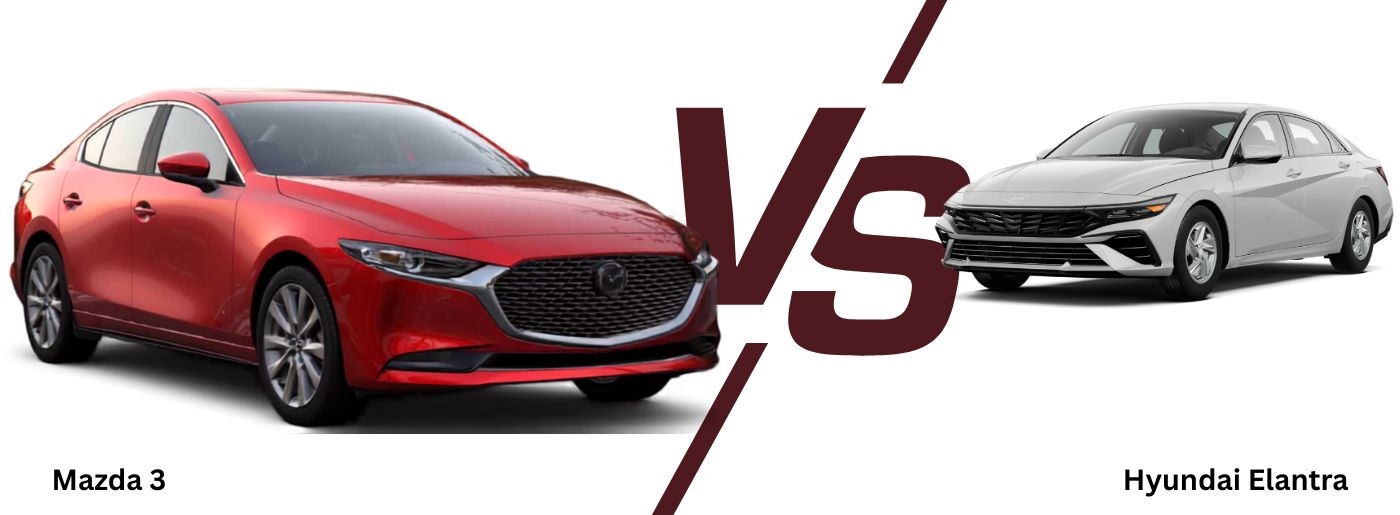
Mazda3 vs. Hyundai Elantra
Five years after Hyundai launched the Excel in the U.S., the Elantra effectively replaced it in 1990. Originally positioned as a value-oriented entry, the Elantra has evolved over seven generations into a reputable compact sedan known for its bold, sometimes controversial styling. The current design, introduced with the 2021 model year, is expected to be refreshed in 2027.
The current model uses a 2.0-liter inline-4 engine that delivers 147 horsepower and 132 lb-ft of torque. The top-tier N Line variant features a turbocharged 1.6-liter engine producing 201 horsepower and 195 lb-ft of torque. Additionally, a hybrid option pairs a non-turbo 1.6-liter inline-4 with electric motors, yielding a combined output of 139 horsepower and 195 lb-ft of torque. The high-performance Elantra N is equipped with a turbocharged 2.0-liter engine generating 276 horsepower, positioning it as a WRX competitor. The Elantra lineup starts at $23,750 and includes trims such as SE, SEL Sport, SEL, SEL Sport Premium, Limited, and N Line.
- There is no AWD version of the Elantra.
- The standard Mazda3 engine has significantly more horsepower (186 vs. 147) and torque (186 vs. 132).
- The turbocharged Mazda3 has considerably more horsepower (227 vs. 201) and torque (310 vs. 195) than the turbocharged Elantra.
- To improve driver engagement, the Mazda3 uses a 6-speed automatic, whereas the Elantra uses a CVT.
- The Mazda3’s standard center touchscreen is slightly larger than the Elantra’s (8.8 vs. 8.0 inches).
- While both models offer 10.25-inch upgrade screens, the Elantra’s large screen requires a wired Apple CarPlay and Android Auto connection. All Mazda3 models support wireless smartphone connectivity.
- Elantra’s dash is attractive for its class but falls short of the Mazda3’s upscale appearance.
- The Mazda3 sedan and hatch earned TOP SAFETY PICK + ratings, the highest offered by IIHS. Elantra earned a TOP SAFETY PICK rating, which is one step down.
- Both models earned Overall 5-star ratings from the NHTSA.
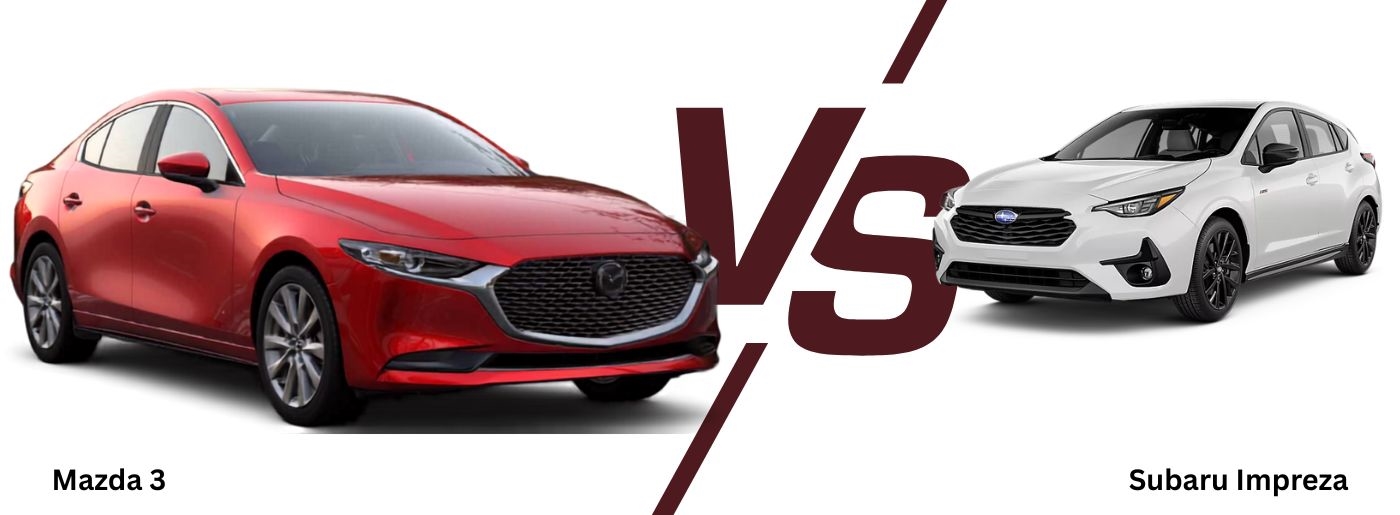
Mazda3 vs. Subaru Impreza
The Subaru Impreza first appeared in the U.S. in 1992, replacing the Leone as the brand’s compact offering. For a time, both front-wheel drive (FWD) and all-wheel drive (AWD) were available, until AWD became standard across the model line in 1996.
The current sixth-generation Impreza, introduced in the 2024 model year, is available only as a hatchback, leaving the sedan body style to the high-performance WRX. There are two trim levels, each with its own naturally aspirated (non-turbo) horizontally opposed (Boxer) inline-4 engine. The Sport has a 2.0-liter engine producing 152 horsepower and 145 lb-ft of torque. The RS features a 2.5-liter engine producing 180 horsepower and 178 lb-ft of torque. Both engines are paired with a Lineartronic continuously variable transmission with available manual shifting across 8 preset ratios.
- The starting prices of the Impreza and the Mazda3 Hatchback are within $100 of each other, though the Mazda3 Sedan is about $1,000 less.
- The base Mazda3 engine is more powerful than both Impreza engines, with horsepower (186 vs. 152 or 180) and torque (186 vs. 145 or 178 lb-ft.).
- The Mazda3's 6-speed manual transmission offers more refined and predictable operation than the Impreza's CVT.
- Overall, reviewers consider the Mazda3 to be a more spirited car to drive than the Impreza.
- The Impreza’s standard center touchscreen is smaller than both Mazda3 screens (8.8 & 10.25 vs 11.6 inches), but the rest of the Mazda3 dash looks more attractive and refined than the Impreza’s.
- The Impreza's 11.6-inch screen has been criticized for slow response times. There are no such criticisms of the Mazda3 screen.
- The Mazda3 earned a TOP SAFETY PICK + award from the IIHS, their highest ranking. The Impreza did not earn any such ranking, likely due to its “Moderate” rating in the Moderate Overlap Front impact test.
Compare the 2026 Mazda3 to the Competition
 This page is best experienced in Landscape Mode.
| Subcompact Crossovers | Mazda3 | Honda Civic | Toyota Corolla | Hyundai Elantra | Subaru Impreza |
|---|---|---|---|---|---|
| Trims | 7 | 6 | 6 | 8 | 2 |
| Colors | 8 | 7 | 15 | 7 | 2 |
| Engine |
2.5 I-4
2.5 I-4 Turbo
|
2.0 I-4
2.0 Hybrid I-4
|
2.0 I-4
1.8 Hybrid I-4
|
2.0 I-4
1.6 T I-4
1.6 Hybrid I-4
|
Sport: 2.0L
RS: 2.5L
|
| Horsepower |
2.5L - 186
2.5T - 227
|
2.0L - 150
2.0L Hybrid - 200
Type-R: 315
|
2.0L - 169
1.8 Hybrid - 138
|
2.0L - 147
1.6T - 201
1.6 Hybrid - 139
|
Sport: 152
RS: 180
|
| Torque |
2.5L - 186
2.5T - 310
|
2.0L - 133
2.0L Hybrid - 232
Type-R: 310
|
2.0L - 151 |
2.0L: 132
1.6 T: 195
|
Sport: 145
RS: 178
|
| Transmission | 6-speed Automatic |
CVT
6-speed Manual (Si, Type-R)
|
CVT | CVT | CVT |
| DriveTrain |
FWD
AWD
|
FWD
AWD
|
FWD
AWD
|
FWD | AWD |
| Fuel Economy (Hwy/City/Comb) |
Sedan: 27 / 36 / 30
Hatch: 26 / 34 / 29
AWD: 25 / 34 / 28
Turbo Sdn: 23 / 32 / 27
Turbo Hatch: 23 / 31 / 26
|
Sdn: 30 / 38 / 34
Hatch: 30 / 38 / 34
Stick: 27 / 37 / 31
Hyb: 50 / 47 / 49
Hyb hatch: 50 / 45 / 48
Typ-R: 22 / 28 / 24
|
32 / 41 / 35
Hyb: 53 / 48 / 50
GR: 21 / 28 / 24
|
2.0L: 31 / 40 / 35
1.6LT: 28 / 35 / 31
|
27 / 33 / 29
27 / 33 / 29
|
| Infotainment |
Standard - 8.8"
Optional - 10.25"
|
Standard - 7.0"
Optional - 9.0"
|
Standard - 8.0"
Optional - 10.25"
|
Standard - 8.0"
Optional - 10.25"
|
11.6" |
| Front Headroom |
Sedan: 38
Hatchback: 37.5
|
39.3 |
Sedan: 38.3
Hatchback: 38.4
|
40.6 | 39.8 |
| Front Legroom | 42.3 | 42.3 | 42.0 | 42.3 | 42.9 |
| Rear Headroom |
Sedan: 37.3
Hatch: 36.5
|
37.1 |
Sedan: 37.1
Hatchback: 37.6
|
37.3 | 38.7 |
| Rear Legroom | 35.1 | 37.4 |
Sedan: 34.8
Hatchback: 29.9
|
38 | 36.5 |
| Cargo Rear Seats Folded (cubic feet) |
Sedan: 13.2
Hatchback: 20.1
|
Sedan: 14.8
Hatchback: 24.5
|
Sedan: 13.1
Hatchback: 17.8
|
14.2 | 20.4 |
| Base Price |
Sedan: $24,650
Hatchback: $25,650 |
Sedan: $24,696
Hatchback: $27,895 |
$23,125 | $22,625 | $26,595 |