Comparing the 2026 Mazda CX-30 to the Competition
The Mazda CX-30 is a perfect example of how Mazda designs and builds products that deviate from others in their respective categories. In this case, many other models in the subcompact crossover category are doing their best to pull sales from the popular compact category by being as large, spacious, and comfortable as possible while still maintaining a subcompact crossover price and footprint. As with many of its models, Mazda has another agenda: designing the CX-30 to be the most engaging model to drive in its class. They also gave it a beautifully cohesive exterior and interior design that easily rivals luxury models. Part of its handling comes from a technology called G-Vectoring Control Plus that applies light braking to the outside front wheels as you straighten out of a corner. You never feel this at work, which is the whole point. The car simply tracks better. The catch is that, in making the CX-30 such a capable and engaging vehicle to drive, it is smaller than most of its class. It has 4 doors and the utility of a crossover, but you won’t see many “ours-is-bigger-than-theirs” points in the comparisons. And unfortunately, driving engagement and satisfaction are difficult to quantify in bullet points.
With the base engine models, most of the driving superlatives go to the lithe and nimble chassis. The 2.5-liter inline-4 is non-turbocharged but large for the category, and its 191 horsepower and 186 lb-ft of torque are in line with its rivals. The engine prioritizes power to deliver a predictable, linear throttle response. While fuel-efficient continuously variable transmissions (CVTs) are common in this category, Mazda uses a 6-speed automatic to improve driving engagement. All-wheel drive is standard on all models. Some reviewers state that the chassis is fully capable of handling more power, so Mazda adds a turbocharged version of the same engine. It is the only model in its class with this large a turbocharged engine, and its 310 horsepower and 227 lb-ft of torque are class-leading.
If you want the most space for your buck, this is honestly not the sub-compact crossover for you. But if you really enjoy driving and find the passenger and cargo space sufficient for your needs, the CX-30 was made for you. The model line contains seven trim levels with the turbocharged engine on the top two.
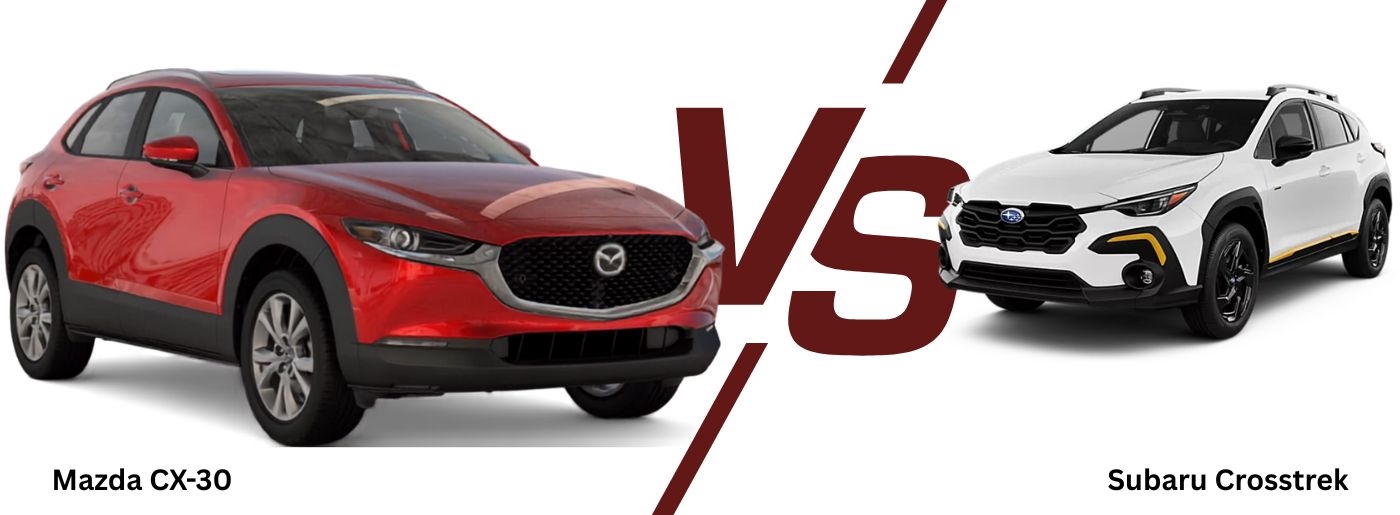
CX-30 vs Subaru Crosstrek
Subaru had plenty of success making a crossover out of a mid-size station wagon with the Outback, and did the same with the Impreza hatchback to create the Crosstrek. In the process, they made one of the most capable off-roaders in the category, with the most ground clearance (particularly in Wilderness trim). The flip side is that the Crosstrek is less thrilling on the highway or a twisty country road.
Power comes from one of two engines: a 2.0-liter flat-4 producing 152 horsepower and 145 lb-ft of torque, or a 2.5-liter flat-4 producing 182 horsepower and 178 lb-ft of torque. As in almost all Subaru models, AWD is standard. Trim levels include Premium, Sport, Limited, and the off-road focused Wilderness.
- Base MSRPs for the CX-30 and Crosstrek are close, with the Mazda having the edge at $26,375 versus $26,995 for the Crosstrek.
- The 186-hp CX-30 base engine is more powerful than both the Crosstrek’s 152-hp base engine and the 182-hp upgrade.
- The 186 lb-ft of torque on the base CX-30 engine is also more than both Crosstrek engines (145 and 178 lb-ft, respectively).
- The CX-30 6-speed automatic provides a more direct connection between driver and drivetrain than the Crosstrek’s CVT.
- The CX-30 has a more upscale dashboard in terms of both design and materials.
- The CX-30 base 8.8-inch center touchscreen is larger than the 7-inch screen on base Crosstrek models.
- The CX-30 provides slightly more, but effectively the same, cargo space behind the rear seat as the Crosstrek. (20.2 vs. 19.9 cubic feet).
- Blind Spot Monitoring with Rear Cross Traffic Alert is standard on all CX-30 models but requires an upgrade for the Crosstrek.
- Both models receive a 5-star overall safety rating from the National Highway Traffic Safety Administration (NHTSA). The CX-30 is also designated a TOP SAFETY PICK + from the Insurance Institute for Highway Safety (IIHS). The Crosstrek has no such designation due to a “Marginal” rating for the moderate overlap front impact test.
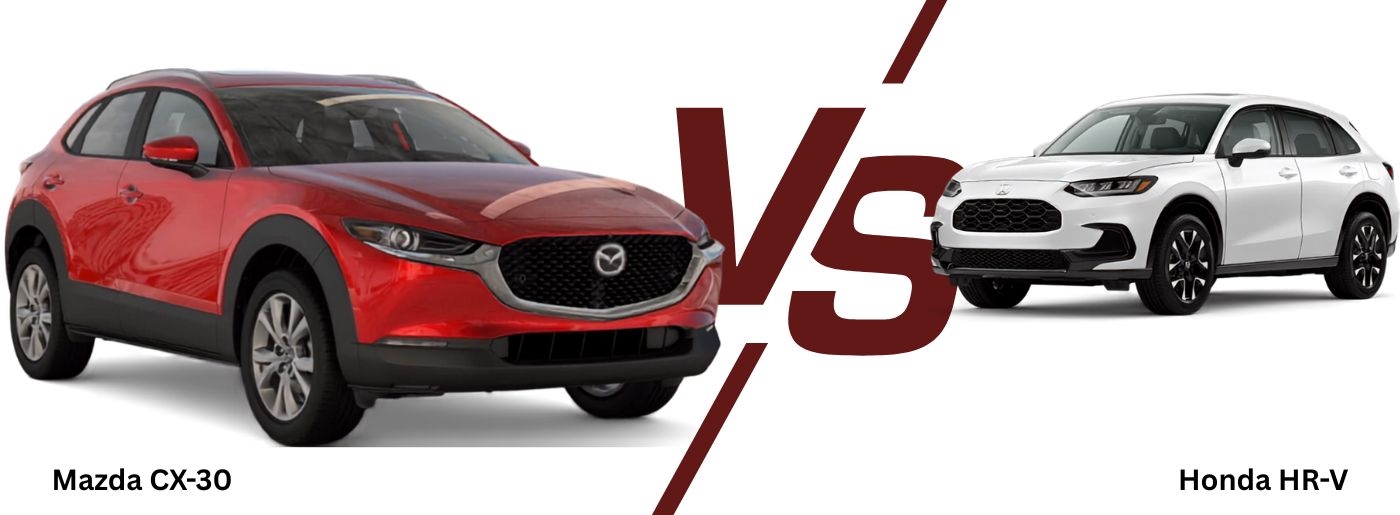
CX-30 vs. Honda HR-V
Honda is no stranger to driving engagement, with its models often scoring second only to Mazda in that area. But that wasn’t a priority for the second-generation HR-V, which Car and Driver describes as “A nicely packaged small utility in search of a more refined and powerful engine.” The sole HR-V engine is a non-turbocharged 2.0-liter inline-4 producing 158 horsepower and 138 lb-ft of torque. The engine is paired with a continuously variable transmission (CVT), and FWD is standard, with AWD available on all trims.
Just as the CR-V is one of the largest models in its class, the HR-V fills the gap with good passenger and cargo space. The interior is derived from the Civic’s, with hidden climate vents and useful physical controls, though only the top trim offers any color other than black. The HR-V is available in LX, Sport, and EX-L trim levels.
- With the HR-V starting at 26,600, the entry price for both models is just a few hundred dollars apart, though that is for the FWD HR-V and AWD CX-30. An AWD HR-V starts at $28,100.
- The CX-30 handily outpowers the HR-V in both horsepower (186 vs. 158) and torque (186 vs. 138 lb-ft), and it shows. Car and Driver found the HR-V taking 9.4 seconds from 0-60, a full second slower than the base-engine CX-30.
- When matched to the CX-30’s standard AWD, both models have very similar EPA-estimated fuel mileage, with the HR-V having a slight edge in the city (24 vs. 25) and the CX-30 on the highway (31 vs. 30), with both sharing the same 27 combined figure.
- The CX-30 6-speed automatic provides a more direct connection between driver and drivetrain than the HR-V’s CVT.
- The CX-30’s standard center touchscreen is larger than the HR-V’s (8.8 vs. 7.0 inches).
- Both models have effectively the same size wheelbase (104.4 vs. 104.5 inches), but the HR-V is over half a foot longer.
- Beauty is subjective, but reviewers found the CX- dash design and materials to be more upscale.
- The HR-V has slightly more front/rear headroom and front /rear legroom, though the CX-30 provides surprisingly more rear hip room (56.2 vs. 47.4 inches).
- Both models get an overall 5-star safety rating from the NHTSA and are designated a TOP SAFETY PICK + from the IIHS (their highest rating).
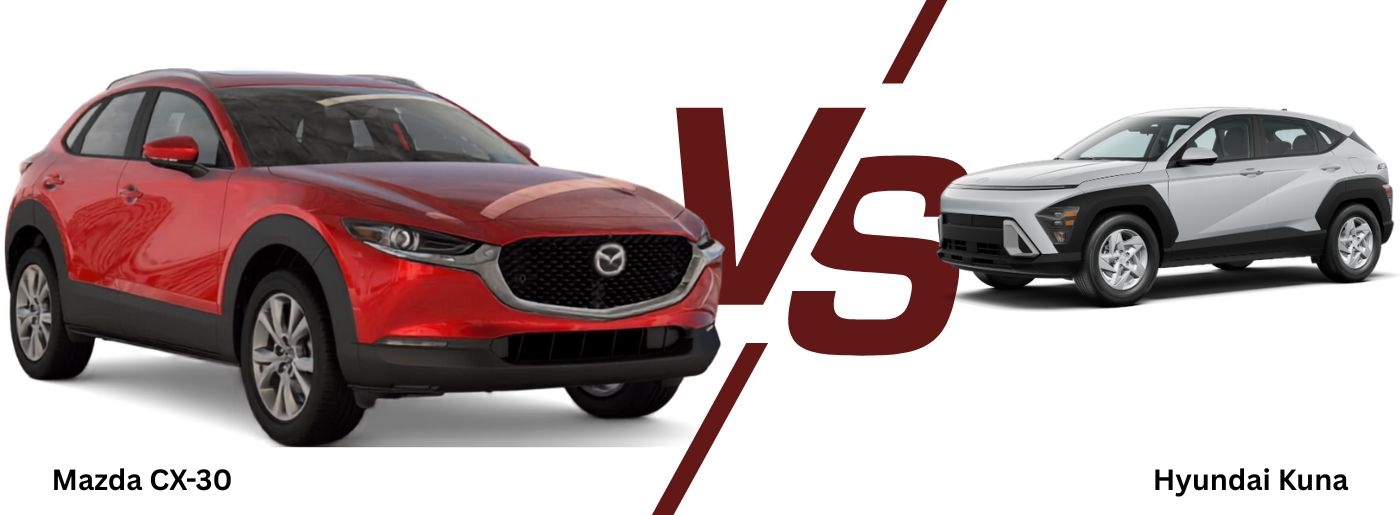
CX-30 vs. Hyundai Kona
The Hyundai Kona first appeared in the U.S. for the 2018 model year as a playful, somewhat overly styled entry in the compact crossover category. The current model is the second design generation, which first appeared in the 2024 model year. There is no hybrid version of the Kona, but there is an EV version. And indeed, even the gas model has an EV look about it with the full-width LED light at the hood’s leading edge. Interior space is generous for the category, and the maximum cargo space is class-leading.
The gas-powered Kona features two engines. The base engine is a 2.0-liter, normally aspirated inline-4 producing 147 horsepower and 132 lb-ft of torque, which makes it the weakest engine in the category. The upgrade is a 1.6-liter turbocharged inline-4 producing 190 horsepower and 195 lb-ft of torque. A CVT manages the power for both engines; FWD is standard, and AWD is available for all trim levels and engine choices. The Kona is available in SE, SEL Sport, SEL Premium, and Limited trim levels.
- The Kona SE has a starting MSRP of $25,500, which is nearly a grand below the CX-30’s starting MSRP. But matching the CX-30’s standard AWD brings the MSRP up to $27,000, which is over the CX-30’s $26,375 MSRP.
- The base engine’s 147 horsepower and 132 lb-ft of torque are the lowest-powered in the category and significantly below those of the CX-30.
- The Kona’s available turbocharged engine has just a little more horsepower (186 vs. 160) and peak torque (186 vs. 195 lb-ft) than the CX-30 base engine. Getting it requires the SEL Premium trim, which, when AWD is added, brings the MSRP to $29,925.
- The Kona model line has nothing to compare with the 310-hp CX-30 turbocharged engine and its 227 lb-ft of torque.
- Rear headroom and front legroom are identical for both models. The Kona has greater front headroom and rear legroom, while the CX-30 has a little more rear hip room. Kona has more cargo space.
- Appearances are subjective, but the CX-30’s smooth exterior contours and elegant dash design have most people finding the CX-30 more attractive and upscale.
- The NHTSA gave the Kona an overall 4-star rating, compared to the CX30’s 5-star rating. Both models have a TOP SAFETY PICK + designation by the IIHS.
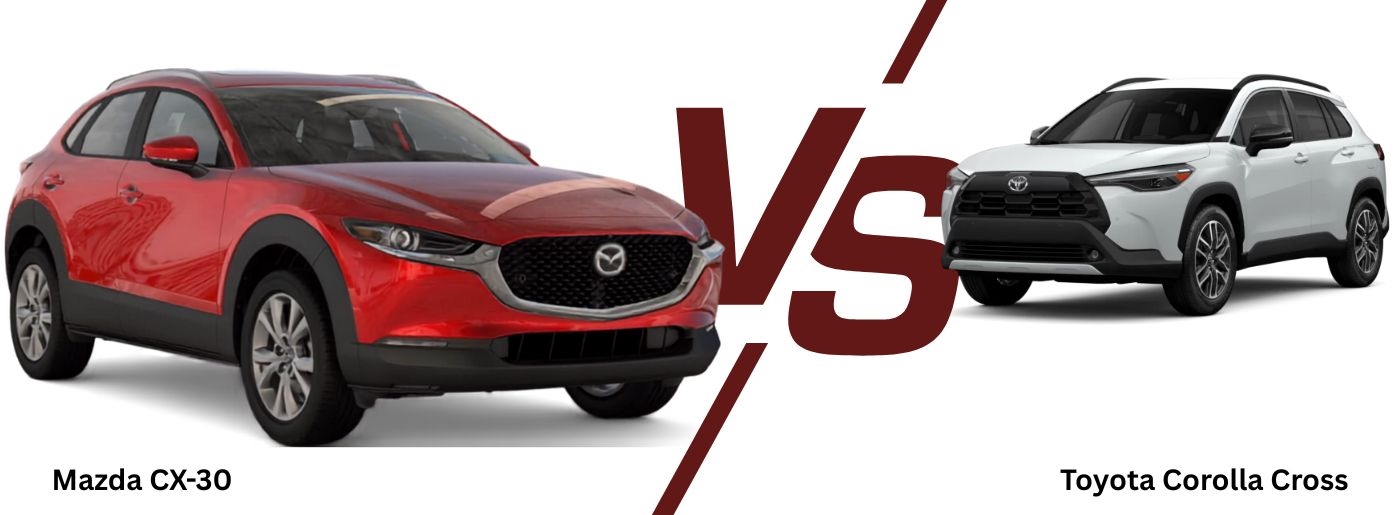
CX-30 vs. Toyota Corolla Cross
It may be classified as an SUV, but the Corolla Cross looks very much like the return of the long-absent Corolla station wagon, albeit with available AWD. It even shares the Corolla’s dash design, much as the CX-30 shares the MAZDA3’s. In 2022, the Corolla Cross replaced the C-HR as a more serious entry in the subcompact crossover class, though its cabin is on the small side, trading metric advantages with the CX-30.
A yin to the CX-30’s yang, the Corolla Cross is all about practicality, though, in Car and Driver’s words, “…lacks any real personality.” It is powered by a 2.0-liter inline-4 producing 169 horsepower and 151 lb-ft of torque. There is also a hybrid version (with its own front-end styling) that uses the same engine and produces 196 horsepower. As usual with its hybrids, Toyota does not provide a total system torque figure. One of the electric motors drives the rear wheels, giving all hybrid models AWD. The Corolla Cross is available in L, LE, and XLE trims.
- The base Corolla Cross MSRP starts at $25,335, but adding AWD raises it to $26,635, just over the CX base price.
- The base CX30 has more horsepower (186 vs. 169) and more torque (186 vs. 151 lb-ft.) than the base Corolla Cross.
- The hybrid model has less horsepower (186 vs. 196) and presumably less total system torque than the CX-30, but it brings the MSRP up to $29,795.
- All Corolla Cross models have a CVT, which arguably provides less satisfying power delivery than a conventional transmission, as found in the CX-30.
- The CX-30's dash design and materials are much more upscale than the Corolla Cross's utilitarian dash.
- Only the CX-30 offers real leather seats in its model lineup.
- The CX-30 has more EPA-measured interior room (94.1 vs. 88.4 cubic feet), but they trade advantages:
- The Corolla Cross has more front/rear headroom (38.1/38.3 vs. 39.5/39.1inches)
- CX-30 has more front/rear shoulder room (55.6/53.6 vs. 52.7/52.6 inches)
- CX-30 has more front/rear hip room (54.6/53.2 vs. 52.6/43.8 inches)
- CX-30 has significantly more rear leg room (36.3 vs. 32 inches)
- Cargo space is very similar. The Corolla Cross has an edge with the rear seats up at 24.0 cubic feet, while the CX-30 prevails when the rear seatbacks are folded (45.2 vs. 44.0 cubic feet).
- The IIHS designated the Corolla Cross as a TOP SAFETY PICK, one step down from the CX-30’s TOP SAFETY PICK + designation.
- Both models earned an overall 5-star rating from the NHTSA
Compare the 2026 Mazda CX-30 to the Competition
 This page is best experienced in Landscape Mode.
| Subcompact Crossovers | Mazda CX-30 | Subaru Crosstrek | Honda HR-V | Hyundai Kona | Toyota Corolla Cross |
|---|---|---|---|---|---|
| Trims | 8 | 5 | 3 | 4 | 3 |
| Colors | 6 | 9 | 8 | 9 | 7 |
| Engine | 2.5-liter
2.5-liter Turbo |
2.0-liter
2.5-liter |
2.0-lter | 2.0-liter
1.6-liter Turbo |
2.0-liter
Hybrid 2.0L |
| Horsepower | 2.5 S - 186
TURBO - 250 |
2.0L - 152
2.5L - 180
HYBRID - 194 Comb. |
158 | 147
190 |
169
Hybrid: 196 |
| Torque | 2.5 S - 186
TURBO - 310 |
2.0L - 145
2.5L - 178 |
138 @ 4200 | 132 @ 4500
195 @ 1700-4500 |
151 @ 4400
Hybrid: n/a |
| Transmission | 6-speed Automatic | CVT | CVT | CVT | CVT |
| DriveTrain | AWD | AWD | FWD
AWD |
FWD
AWD |
FWD
AWD |
| Fuel Economy (Hwy/City/Comb) | 24 / 31 / 27
Turbo: 22 / 30 / 25 |
2.0L - 27 / 34 / 29
2.5L - 26 / 33 / 29 |
FWD: 26 / 32 /28
AWD: 25 / 30 / 27 |
2.0 FWD: 28 / 35/ 31
2.0 AWD: 27 / 29 / 28
1.6T FWD: 26 / 31 / 28
1.6T AWD: 25/ 28 / 26 |
FWD - 31 / 33 / 32
AWD - 29 / 31 / 30
Hyb: 46 / 39 / 42 |
| Infotainment | Standard - 8.8
Optional - 10.25 |
Standard - 7
Optional - 11.6 |
9 | 12.3 | Standard - 8
Optional - 10.5 |
| Front Headroom | 38.1 | W/O Moonroof - 39.8
W/ Moonroof - 38.7 |
39.4 | 39.9 | 39.5 |
| Front Legroom | 41.7 | 42.9 | 41.9 | 41.7 | 42.9 |
| Rear Headroom | 38.3 | W/O Moonroof - 38
W/ Moonroof - 38 |
38 | 38.3 | 39.1 |
| Rear Legroom | 36.3 | 36.5 | 37.7 | 38.2 | 32 |
| Cargo Behind Rear Seats (cubic feet) | 20.2 | 19.9 | 24.4 | 25.5 | FWD - 21.5 - 24.0 |
| Cargo Rear Seats Folded (cubic feet) | 45.2 | 54.7 | 63.7 | 55.1 | FWD - 46.9
AWD - 44 |
| Base Price | $26,375 | $26,995 | $26,600 | $25,500 | $25,235 |