Comparing the 2026 Mazda CX-5 to the Competition
For 2026, Mazda introduces the new generation of our most popular vehicle – the CX-5.
The reason for its success over the years is that the CX-5 is perfectly suited for everyone. It now offers more interior space and improved technology, including a larger, more intuitive center touchscreen display, while retaining the best of what this SUV offers. The shape may be familiar, but the details are what make it stand out from longer rear doors to the elevated rear end.
For 2026, the CX-5 will only come with our 187-horsepower SKYACTIV-G 2.5-liter four-cylinder engine, six-speed automatic transmission, and standard all-wheel drive. There will be powertrain options in the near future.
You have a choice of trim levels: 2.5 S, 2.5 S Select, 2.5 S Preferred, 2.5 S Premium, and 2.5 S Premium Plus. All are well-equipped and priced for great value.
Is the 2026 CX-5 the right SUV for you? Let’s see how it compares to its competition.
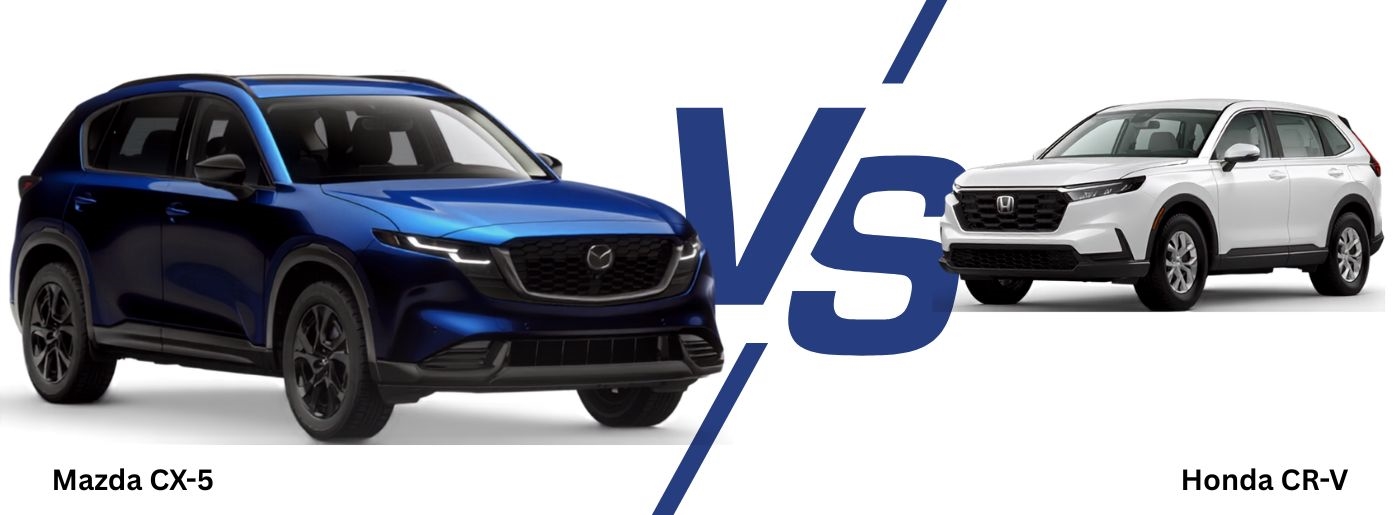
CX-5 vs Honda CR-V
Honda’s popular SUV features a bold design, five-passenger seating, and expansive cargo space. Powered by either a 1.5-liter turbocharged engine or a 2.0-liter hybrid driveline, driving either the front- or all four wheels. There are eight trim levels available, including the rugged TrailSport Hybrid model.
- Mazda CX-5 rear seat occupants will enjoy more headroom over the CR-V (40.2” vs. 38.2”)
- The CR-V’s standard turbocharged engine has less torque than the naturally aspirated standard engine on the CX-5. The Mazda offers 186 pound-feet of low-end performance compared to the Honda’s 179 pound-feet.
- The CX-5’s new center touchscreen display is larger at 12.9 inches diagonal than the one in the CR-V at nine inches. The Mazda system offers more features and interactivity than the Honda.
- All CX-5 models are equipped with standard all-wheel drive. It is an option on non-hybrid CR-V models.
- With standard all-wheel drive, the CX-5 is a better value with a lower starting MSRP – just over $1,000 less than the base CR-V with front-wheel drive.
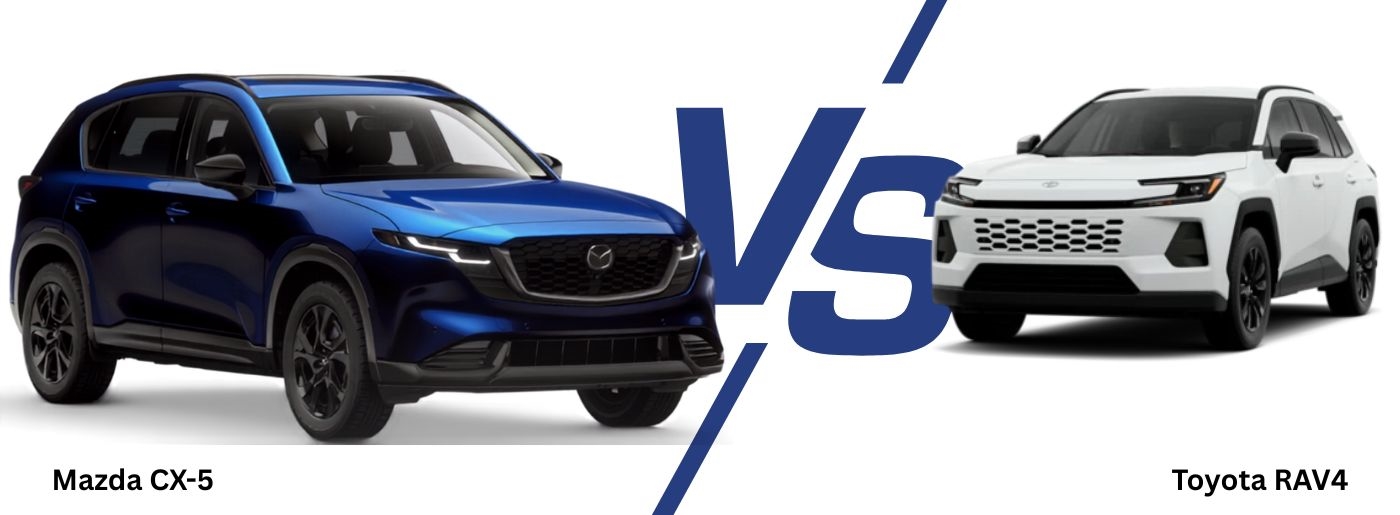
CX-5 vs. Toyota RAV4
The Toyota RAV4 is also all-new for 2026, featuring a new design inside and out and an all-hybrid driveline lineup. The standard hybrid engine is a 2.5-liter four-cylinder, while the plug-in hybrid is based on the same motor set. There is a total of nine trim levels in this year’s lineup, including the rugged Woodland and Woodland PHEV, along with a PHEV GR Sport.
- The CX-5’s new center touchscreen display is larger at 12.9 inches diagonal than the one in the RAV4 at 10.5 inches. The Mazda system offers more functions and interactivity than the Toyota system.
- It might shock you that the CX-5 has more passenger volume than the RAV4. While the Toyota is measured out at 98.9 cubic feet, the Mazda has up to 106.5 cubic feet for up to five passengers to stretch out.
- A longer wheelbase means you get a smoother ride overall. That is why the CX-5’s new 110.6-inch wheelbase is longer than the RAV4’s 105.9 inches.
- All CX-5 models are equipped with standard all-wheel drive. It is an option on comparable RAV4 models.
- With standard all-wheel drive, the CX-5 is a better value with a lower starting MSRP – just over $2,000 less than the base RAV4 hybrid with front-wheel drive.
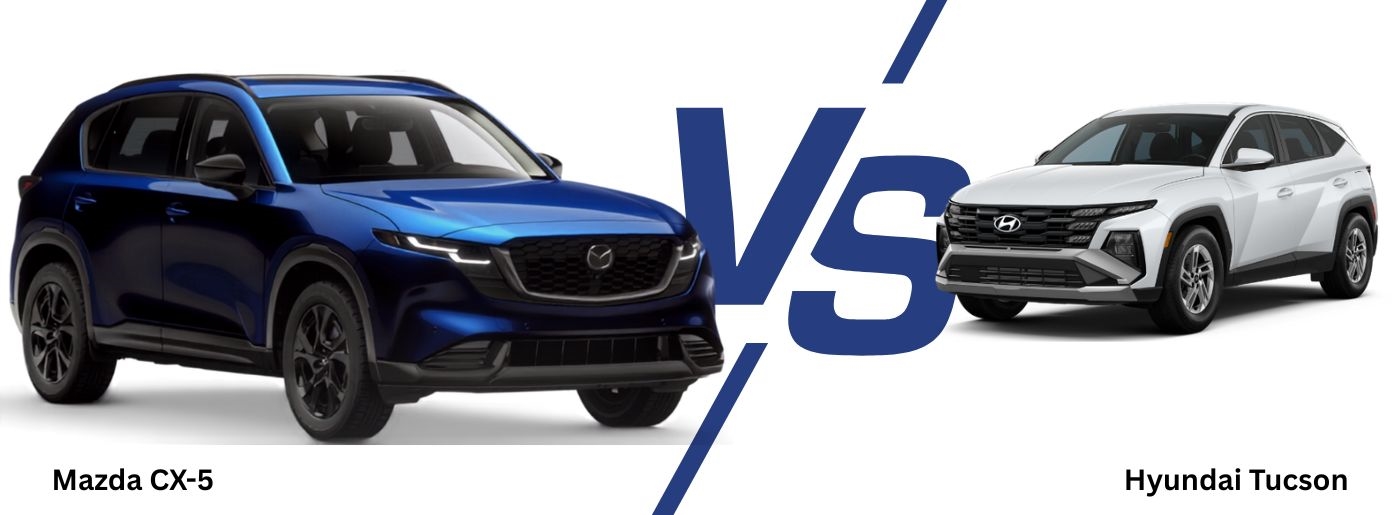
CX-5 vs. Hyundai Tucson
The Tucson is both stylish and efficient, while carrying up to five people inside its SUV shell. It is offered with three drivelines: a 2.5-liter gas engine, a hybrid, and a plug-in hybrid. You also have a choice of six gas models, four hybrid models, and two plug-in hybrid models. You can choose between front- or all-wheel drive.
- The CX-5’s new center touchscreen display is larger, at 12.9 inches diagonal, than the one in the Tucson, at 12.3 inches. Stepping to the Premium Plus trim increases the center display screen to 15.6 inches – larger than the comparable trim in the Hyundai.
- The Tucson’s standard engine has less torque than the naturally aspirated standard engine on the CX-5. The Mazda offers 186 pound-feet of low-end performance compared to the Hyundai’s 178 pound-feet.
- All CX-5 models are equipped with standard all-wheel drive. It is an option on comparable Tucson models.
- With all-wheel drive, you want to make sure you can go further on a tank of gas. The CX-5's combined fuel economy is 26 MPG, matching the Tucson’s 26 MPG. However, it also helps that the Mazda’s fuel tank is larger (15.3 gallons vs. 14.3 gallons) for better range.
- A longer wheelbase means you get a smoother ride overall. That is why the CX-5’s new 110.6-inch wheelbase is longer than the Tucson’s 106.5 inches.
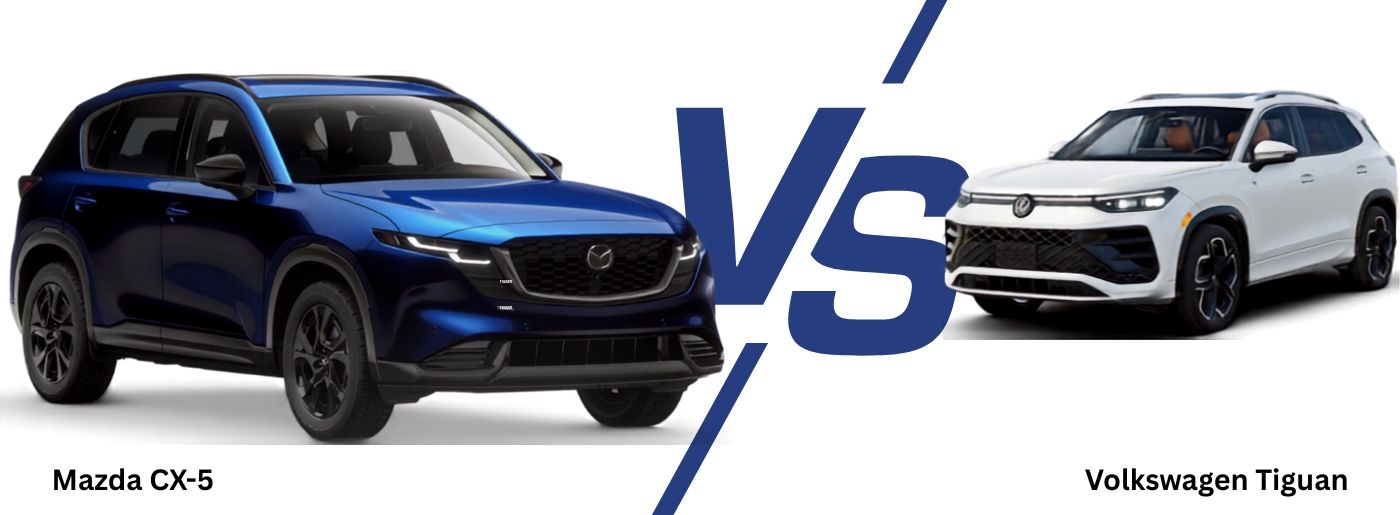
CX-5 vs. Volkswagen Tiguan
Improved back in 2025, the Tiguan offers a more elevated cabin to go along with its clean exterior design. Two 2.0-liter turbocharged engines are available – rated at 201 and 268 horsepower. With an eight-speed automatic, the Tiguan can be driven with front-wheel drive or through an all-wheel-drive system. There are four trim levels available, including a powerful SEL R-Line Turbo.
- Overall passenger volume in the Tiguan is impressive, with 103.8 cubic feet. However, the CX-5 offers more passenger space with up to 106.5 cubic feet for up to five passengers.
- In recent crash testing by the Insurance Institute for Highway Safety, the 2026 CX-5 received its TOP SAFETY PICK+ designation. The Tiguan did not make the grade this year. When it comes to safety, Mazda has a better overall track record than Volkswagen.
- All CX-5 models are equipped with standard all-wheel drive. It is an option on comparable Tiguan models.
- With all-wheel drive, you want to make sure you can go further on a tank of gas. The CX-5’s combined fuel economy is 26 MPG, compared to the Tiguan’s 25 MPG. It also helps that the Mazda’s fuel tank is larger (15.3 gallons vs. 14.5 gallons) for better range.
- With standard all-wheel drive, the CX-5 is a better value with a lower starting MSRP – just around $1,000 less than the base Tiguan with front-wheel drive.
Compare the 2026 Mazda CX-5 to the Competition
 This page is best experienced in Landscape Mode.
| Compact Crossovers | Mazda CX-5 | Honda CR-V | Toyota RAV4 | Hyundai Tucson | Volkswagen Tiguan |
|---|---|---|---|---|---|
| Trims | 5 | 8 | 10 | 11 | 3 |
| Colors | 7 | 8 | 10 | 9 | 9 |
| Engine | 2.5-liter |
1.5-liter Turbo
2.0-liter Hybrid
|
Hybrid - 2.5-liter |
Gas - 2.5-liter
Hybrid - 1.6-liter Turbo
|
2.0-liter Turbo |
| Horsepower | 187 |
Gas - 190
Hybrid - 204
|
FWD: 226
AWD: 236
PHEV: 324
|
Gas - 187
Hybrid - 231
Plug-in - 268
|
201
SEL-R: 268
|
| Torque | 186 |
Gas - 179
Hybrid - 247
|
N/A |
Gas - 178
Hybrid - 271
Plug-in - 271
|
FWD - 207
AWD - 221
SEL-R: 258
|
| Transmission | 6-speed Automatic | CVT | CVT | Gas - 8-spd auto
HEV/PHEV - 6-spd auto |
8-spd auto |
| DriveTrain | AWD | Standard - FWD
Optional - AWD |
Standard - FWD
Optional - AWD |
Standard - FWD
Optional - AWD |
Standard - FWD
Optional - AWD |
| Fuel Economy (Hwy/City/Comb) | 24 / 30 / 26 |
FWD: 28 / 33 / 30
AWD: 27 / 31 / 29
Hybrid FWD: 43 / 36 / 40
Hybrid AWD: 40 / 34 / 37
|
FWD: 47 / 40 / 43
AWD: 46 / 39 / 42
|
FWD: 25 / 33 / 28
AWD: 24 / 30 / 26
Hybrid Blue: 38 / 38 / 38
Hybrid FWD: 36 / 37 / 36
|
FWD: 26 / 34 / 29
25 / 32 / 28
AWD: 22 / 32 / 25
22 / 29 / 25
|
| Infotainment |
Standard - 12.9
Optional - 15.6
|
Standard - 9
Optional - 10.2
|
Standard - 10.5
Optional - 12.5 |
12.3 |
Standard - 12.9
Optional - 15
|
| Front Headroom | 39.7 | 40 | 36.7 | 40.1 | 39.5 |
| Front Legroom | 41.7 | 41.3 | 41.0 | 41.4 | 40.2 |
| Rear Headroom | 40.2 | 38.2 | 36.7 | 39.5 | 39.7 |
| Rear Legroom | 39.9 | 41 | 37.8 | 41.3 | 40.2 |
| Cargo Behind Rear Seats (cubic feet) | 33.7 | 39.3 | 36.6-37.8 | 38.7 | 33.8 |
| Cargo Rear Seats Folded (cubic feet) | 66.5 | 76.5 | 69.8-70.4 | 74.8 | 69.8 |
| Base Price | $29,990 | $30,920 | $31,900 | $29,450 | $30,805 |